
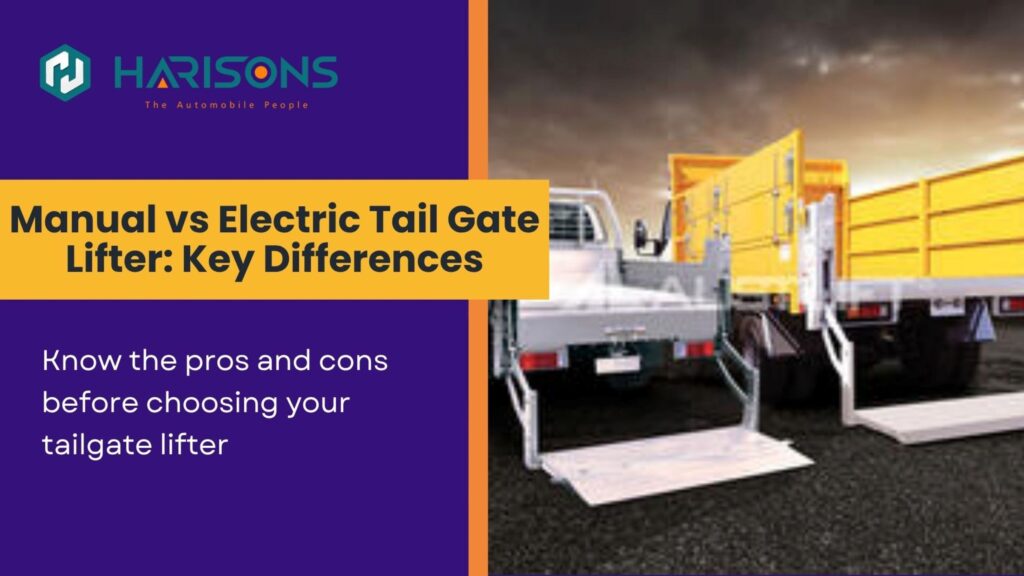
Imagine you are standing at the back of your car, arms full of shopping bags or luggage, rain begins to pour down, and you still have to lift the tailgate manually. It is not just inconvenient, it is a moment that every vehicle owner fears. On the other hand, picture tapping a button or waving your foot under the bumper, and the tailgate glides open effortlessly, hands-free, convenient, and smooth.
This contrast perfectly captures the key difference between a simple manual tailgate lifter and a slick electric tailgate lifter. Further, in this blog post, we will uncover some of the key differences between a manual tailgate and an electric tailgate. But before that, we will know what they actually stand for.
What is an Electric Tail Gate Lifter?
An electric tailgate, which is also known as a power tailgate, is a vehicle feature that enables the hatch of a car or pickup to open and close electrically rather than manually. In simple terms, instead of using manual/physical force to lift a tailgate, with evolving technology, we can use sensors, motors, and a simple button-press to lift open a tailgate.
What is Manual Tail Gate Lifter?
A manual tailgate refers to the hatch or a gate of a vehicle that can be opened and closed entirely with physical effort, by hands, rather than with an electric motor or automated mechanism. This means the user lifts, lowers or secures the tailgate using their own muscle, aided only by struts or gas-springs, not powered by technology. In the automotive context, this is the simpler, traditional form of the rear access door.
Key Differences between Electric Tail Gate Lifeter and Manual Tail Gate Lifter
Here are the key differences between a manual tailgate and an electric tailgate, explained in detail. These differences will help you understand how they compare, identify with different features that differ, and determine what might better suit your vehicle or a purchasing decision.
| Features | Electric Tailgate | Manual Tailgate |
| Operation | Automated through a button or a sensor | A fully manual operation by hands |
| Efforts required | Lesser physical efforts | Comparatively higher physical efforts |
| Common Features | Technologically advanced features | Fundamental, conventional and minimal technological features |
| Safety Features | Enhanced safety feature, usually with a soft closing | Basic safety features and closing solely depend on the user. |
| Maintenance | Complex maintenance with a higher cost | Simpler maintenance with easier upkeep |
| Vehicle Cost | Higher vehicle cost at the time of purchase | Less vehicle cost compared to an electric one. |
| Best for | Frequent use | Occasional use |
| Trade-offs | Electrical dependency with a higher cost | Fewer features, which require more effort. |
Hence, these are some of the basic key differences that a consumer and a user need to keep in mind while purchasing.
Conclusion
As you weigh the decision between a manual tailgate lifter and an electric one, remember that the right choice depends not just on what technology offers, but on how you use your vehicle, what your budget allows, and what trade-offs you are willing to accept. A manual tailgate keeps things simple, rugged and cost-effective. Whereas an electric lifter brings convenience, smoothness, upscale features, but also adds complexity and cost.
When it comes to selecting not just a tailgate lifter but a partner you can trust to deliver quality and reliability, Harisons stands out. Selecting a brand like Harisons gives you confidence that the product has been designed and manufactured with automotive durability in mind.