
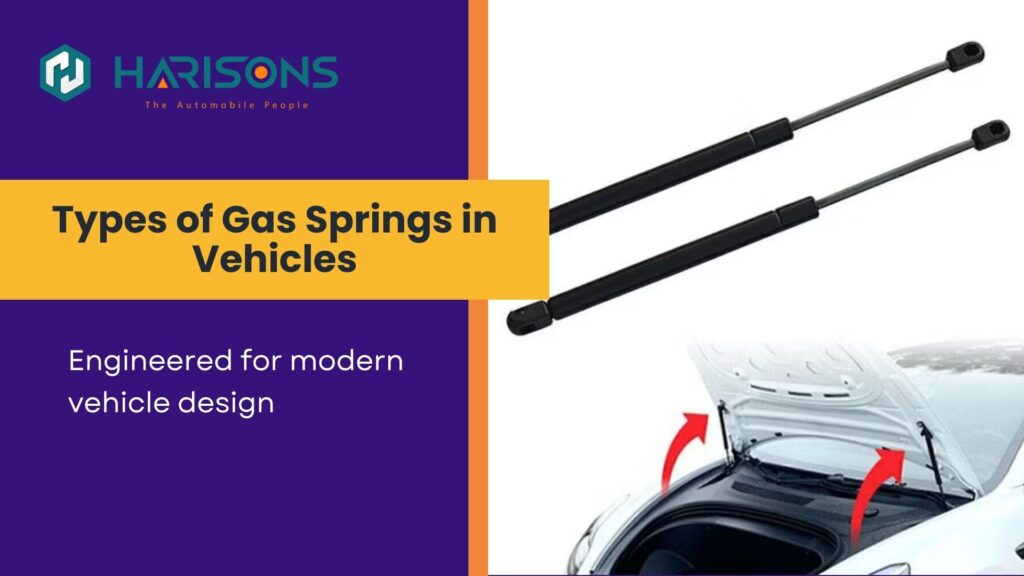
Gas springs play a crucial role in modern automotive manufacturing, supporting comfort, safety, and functionality across a wide range of vehicle systems. From lifting a vehicle hood effortlessly to enabling precise seat and steering adjustments, these components are designed to control motion smoothly and reliably.
Understanding the types of gas springs used in automotive applications is crucial for engineers, designers, and manufacturers, as each type is specifically designed to meet distinct performance requirements, space constraints, and operating conditions. By selecting the right gas spring, automotive manufacturers can improve durability, user experience, and overall vehicle quality while meeting increasingly complex design demands.
Main Types of Gas Springs in Automotive Manufacturing
Gas springs, commonly known as gas struts, are essential mechanical components in vehicle design, helping control motion, support loads, and improve user comfort. In automotive applications, understanding the types of gas springs is important for selecting the right solution for performance, safety, and durability.
- Non-Locking Gas Springs: Non-locking gas springs provide continuous lifting or lowering assistance but cannot hold a fixed position when external force is removed. They operate using compressed gas that extends the piston rod smoothly and retracts under load.
- Locking Gas Springs: Locking gas struts are designed with an internal locking mechanism that allows them to hold a load securely at a chosen position. Locking can be activated mechanically, hydraulically, or electrically, depending on the design.
- Damping Gas Springs: Damping gas springs incorporate oil or hydraulic damping to control movement speed, especially near the end of the stroke. This prevents sudden closing or opening and reduces noise and wear.
- Adjustable Force Gas Springs: These types of gas springs allow the output force to be adjusted by adding or releasing gas, making them ideal for applications with changing load requirements. They are commonly used during testing or in customised vehicle designs.
- High-Force Gas Springs: High-force gas struts are engineered to support heavier loads and operate under higher internal pressure. They are built with stronger materials and seals to ensure reliability under demanding conditions.
- Traction (Pull-Type) Gas Springs: Unlike standard push-type designs, traction gas springs work by pulling the rod into the cylinder. This design is useful when pushing force is not suitable due to space or mechanical constraints.
- Miniature Gas Springs: Miniature gas struts provide controlled motion in compact spaces where standard-sized components cannot fit. Despite their small size, they offer reliable performance and smooth operation.
- Lockable Damping Gas Springs: These advanced types of gas springs combine locking capability with damping control. They allow secure positioning while ensuring smooth and controlled movement during adjustment.
Therefore, the wide range of types of gas springs used in automotive manufacturing allows engineers to meet diverse functional and design requirements. By selecting the appropriate gas spring or gas strut, manufacturers can enhance vehicle safety, comfort, and long-term performance while ensuring smooth and reliable operation across automotive systems.
Benefits of Using the Right Type of Gas Spring
Selecting the correct gas spring is essential for achieving reliable performance and smooth operation in vehicle systems. In automotive design, the proper choice of automotive gas springs or an automotive gas strut directly affects safety, comfort, durability, and overall vehicle quality.
- Improved Safety: Using the appropriate automotive gas spring ensures controlled movement and secure load support. Properly matched force and damping reduce the risk of sudden closing, component failure, or user injury.
- Smooth and Controlled Operation: The right automotive gas strut provides consistent motion control, allowing components such as hoods, tailgates, and seats to open and close smoothly without jerking or slamming.
- Enhanced User Comfort: Correctly selected automotive gas springs improve ease of use by minimising effort during lifting or adjustment. This enhances driver and passenger comfort, especially in adjustable seating and interior systems.
- Increased Component Lifespan: When the correct type and force rating are used, automotive gas struts experience less stress and wear. This leads to longer service life and reduced maintenance or replacement costs.
- Better Load Handling and Stability: Choosing the right automotive gas spring ensures stable support for both light and heavy components. This stability is especially important for tailgates, engine covers, and commercial vehicle applications.
- Optimised Space and Design Flexibility: Properly sized automotive gas springs allow for compact and efficient design solutions, enabling engineers to maximise space and integrate components seamlessly into vehicle structures.
- Improved Noise and Vibration Control: High-quality, well-matched automotive gas struts reduce noise and vibration during operation, contributing to a quieter and more refined driving experience.
Hence, using the right type of gas spring is essential for achieving safe, smooth, and durable vehicle performance. Careful selection not only enhances functionality and comfort but also supports long-term reliability and efficient automotive design.
Conclusion
In automotive manufacturing, understanding the types of gas springs is essential for achieving safe, efficient, and user-friendly vehicle designs. From basic lifting functions to advanced adjustable and damping applications, each gas strut is engineered to meet specific performance and load requirements. Choosing the right gas springs not only improves vehicle functionality and comfort but also enhances durability and long-term reliability.
Manufacturers benefit most when they work with experienced suppliers who focus on engineering precision, consistent quality, and application-specific solutions. In this context, companies such as Harisons India are often considered for their technical expertise, manufacturing capability, and commitment to reliable automotive components, making them a trusted choice within the industry without the need for overt promotion.